%20(2).png)

Vesperian Holidays
Vesperian Witches observe a variety of holidays according to our tradition and faith. Some of these holidays you might recognize from European paganism and modern occult circles. Others, however, are unique to Vesperianism. This page will discuss the ways both solitary and group-based Vesperians may observe our sacred days.

Lupercalia
Feb 15
Lupercalia was an ancient Roman pastoral festival observed to purify the city and celebrate fertility and health. It was dedicated to Lupercus, a god associated with fertility, shepherds, and wild animals, sometimes linked to Faunus, the Roman equivalent of Pan. The name Lupercalia comes from Lupercus and Lupercal, the cave where, according to legend, Romulus and Remus were suckled by the she-wolf (lupa).
Vesperians observe this day to celebrate many of the same things: fertility, health, vitality, wellbeing. However, we also see it as a day of vital sexuality, love, primality, and shadow-work. It is also a day to celebrate romantic relationships for those in them. Common practices for the Vesperian on this day include offerings (to Lilith, Asmodeus, and other similar spirits), the drinking of wine, cleansing baths, and rites of love, fertility, vitality, etc. Rites involving the power of sexual magick are also enacted by many observants. For the solitary practitioner, a fancy dinner, candlelit altar and ritual bath (with a rite of self-love or sex) is an excellent way to celebrate. Indulge yourself in excess!
In group settings, temples and covens should provide offerings of blood, pomegranates, goat hide or meat, roses, and plentiful perfume and incense. A particularly indulgent Black Mass must be held. Groups may wish to observe further rites of indulgence at their discretion.

Benediction Day
April 8
Benediction Day marks the yearly anniversary of the pact formed between the founders of Vesperianism and the Devil, thereby establishing Vesperianism as a wellspring of energy for witches to draw from. We celebrate this pact because it has allowed many such witches to attain the Vesperian Benediction and establish a relationship with the Three Satans. It is the anniversary of the Great Western Eclipse of 2024, when the Devil's Comet could be seen alongside the solar eclipse.
For the solitary practitioner, Benediction Day is observed with deep thoughtfulness towards one's relationship with Samael. Offerings and time spent at one's altar are imperative for this time. This is a most glorious night to perform one's Self-Initiation Ritual. It is also customary to leave 3 black candles in your window, near your home's door or entryway, or upon your altar, to symbolize the Three Satans.
In group settings, Benediction Day is observed with a Black Mass, as well as other ceremonies. Congregations should focus on rituals which involve the amplification of the Black Light/Flame. A truly devotional Vesperian should anoint their forehead or either hand with the Mark of the Devil, drawn in ash, blood, gravedirt, ink, or herbs.

Walpurgis Night
April 30
Walpurgis Night is a European folk festival historically associated with the transition into spring and, in later Christian folklore, gatherings of witches. It is traditionally tied to the famed Witches' Sabbat and is said to be a night where witches gather on hilltops to consort with Satan, feast, engage in ritual acts, dance, and perform other so-called blasphemies. It is said according to folktale to be the night many new witches sign their names in the Devil's Black Book and strike infernal pacts.
To the Vesperian, Walpurgis Night is indeed a night where we gather as one people guided by the One True Satan. Vesperians often engage in rituals involving meditation, astral projection, and energywork. It is indeed the hope and aim of many who practice to achieve astral projection and join the spirits of other Witches in their infernal consorting. This is a night to brew the signature Vesperian Flying Tea or apply the Vesperian Flying Ointment. On this night, the Vesperian may wish to conduct any manner of magick and see it succeed, especially dark rites involving demonic forces or shades of the dead. Remember, this night is exactly half a year away from October 30, All Hallow's Eve. The spiritual veils of our world and the next are just as thin on this night as on Samhain. It is a night to appreciate ancestors and the shades of the dead.

May 1
Beltane
Beltane is a Gaelic festival marking the midpoint between spring and summer, historically associated with fertility, fire, and seasonal change. It was believed to mark the height of spring or the beginning of summer, and was a time in Pagan Europe where the Gaels would put their livestock out to pasture, often engaging in rituals involving the passing of livestock between two fires to ward off disease or misfortune. The popular Maypole traditions of Europe were common during the festivities.
In Vesperian practice, Beltane is a celebration of fire and the vigor of life. It is a celebration of wildness and growth, freedom, prosperity, and good fortune. It is a celebration of family (when applicable) and community, and is best celebrated with a feast and dancing. The Vesperian should take careful extra time to be surrounded by nature on this day, to smell flowers, and to have meaningful engagement with the elements.
We recommend gathering flowers on this day and using them for any manner of things: to build magickal wreaths, to use in cleansing baths, as decor, and to use in spellwork. Fire-gazing and scrying are ideal for this day, as are any spells dedicated to the earth spirits or intended for money, prosperity, and health. In group settings, Vesperians should host festivals and parties on this day with plentiful food and beverage, dancing, and any form of merriment desired.

May 12
Lemuria
Lemuria was an ancient Roman festival intended to appease restless spirits and remove harmful ghosts from the household. These specters, often called lemures or larvae, were propitiated with chants and offerings of black beans. While often celebrated with festivities across several days (usually May 9, 11, and 12). We celebrate this day on the 12th but encourage a seasonal observance of the holiday for those days.
In Vesperianism, Lemuria is observed as a time of addressing unresolved spiritual, psychological, or other life issues. It is time to clean and cleanse the home and living space, repair and recharge the hearth, and banish all negativity from the home. It is time to perform banishment rituals like the Rite of the Pentagrams (the Vesperian LBRP) . We also recommend taking cleansing baths, charging your ritual tools, and petitioning our gods for protection on this day. Take an inventory of your life and remove anything no longer serving you.
In group settings, Vesperians should gather to rid themselves of any weights or energies which impede their ability to live happily and with contentment, or anything which impedes the ability to serve the Three Satans. We encourage group rites of banishment and cleansing, including rites involving the immolation of objects which represent old hindrances and parts of life that were difficult, painful, traumatic, or represent a particularly heavy failure or defeat. By burning those objects as a group, you are affirming to one another that those days are over. After these rites, each member must bless one another.

June 6
Day of the Beast
The Day of the Beast is celebrated on the sixth day of the sixth month of the year, beginning at the sixth hour. It defiantly celebrates the unbridled Will of the Vesperian people, and our unflinching identity as Witches in a world that is unkind to us. It is a day of affirming yourself as a Witch and a Child of Satan. Celebrate by performing rituals dedicated to the Spirit of the Antichrist, and by extension, the Three Satans. We use this day to celebrate the coming of the Antichrist and His era of advancement and humanism.
Groups are encouraged to feast and dance as is typical of most Vesperian summer rites. However, rites of blasphemy and malediction are perfect for this day, as are any other rites most wicked. Performing woodland ceremonies involving anointing each other with blood or ash is also ideal. If you are a practitioner who engages in sexual rites, the night is perfect for this as well. Vesperians should assemble beneath large effigies of the Beast on this day and offer burnt offerings before it. On this day, it is also appropriate to remember those Witches who have gone before you in whatever ways you see appropriate and to pray for their restful and renewed life in the Underworld.
Sprinkle black salt, mandrake root, or devil's claw at your door to invite the Beast in and keep anything uninvited out. Boil a simmer pot of bones, flowers, and other safe herbs associated with the Devil to create a welcoming environment for the Great Satan. Create or renew effigies of the Three Satans in your home and dress them in gifts such as jewelry, fine clothes or veils, oils and perfumes, etc.
Midsummer
June 20
The Summer Solstice, also known in many traditions as Midsummer, is the longest day of the year and has been widely celebrated across European and global cultures. In some neopagan circles, especially Germanic, the reconstructed version of this holiday is called Litha. Archeological evidence suggests the significance of the summer solstice in the Northern Hemisphere of the world since the neolithic era. In the City of Rome, it was a festival commemorating the goddess Fors Fortuna. Practitioners rowed in boats along the River Tiber to the temples of Fortuna. There, they would perform secret rituals wherefrom they'd row back covered in garlands and inebriated.
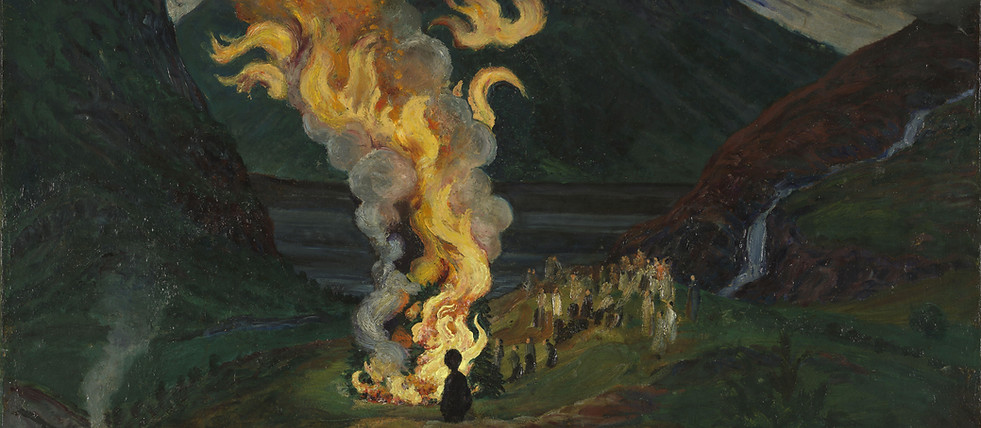
Vesperians should seek to observe the powers of sunrise and sunset on this day, choosing to meditate or perform rituals on either or both times. It is recommended, especially in groups and Vesperian families, to form bonfires and share stories and tales orally with each other and to eat plentiful moist food. Vesperian temples or covens may also select from among them a "Summer Queen" (or "Fire Queen") who embodies the vigor of summer to lead a few of the rituals and ceremonies conducted throughout the day. This decision must be agreed upon by the whole group. Failure to choose a Summer Queen through peaceful and agreeable means may result in ill luck.
The Summer Queen should be someone who has had a rough year, or has otherwise experienced fierce challenges that they have been able to overcome or shine through. Pregnant women and mothers, heartstrong maidens, and others who stand strongly in their feminine aspect, etc. are excellent candidates to consider. The Summer Queen may choose to select for herself a willing Summer King, but only if she chooses. The Summer King is a mere consort in this scenario and must show his love, appreciation, and willingness to serve the Summer Queen on this day. The group leaders must help the Summer Queen in all her efforts.
On this day we also show appreciation for the fairyfolk and the earthly spirits who are friendly towards the Children of the Devil. The Summer Queen should consort with the Queen of Elphame and provide her with offerings and ask for her to send good familiars and spirits to the group for the rest of the year.

July 2-3
Otia
Otia is not drawn forth from any singular tradition, but comes as a modern Vesperian response to a real social disorder. The name of the holiday, which lasts 2 days, is derived from the Latin otium, meaning leisure, peace, or freetime from daily duties. In ancient Rome, the term was not used for mere idleness, but a purposeful state of rest dedicated to self-improvement, contemplation, reading, writing, and intellectual or artistic pursuits. The opposite of this was negotium, which pertained to the demands of business and public life.
Within Vesperianism, Otia reminds practitioners that periods of restoration and reset are necessary for wisdom, creativity, and spiritual health. Solitary practitioners are encouraged to set aside work, avoid unnecessary obligations, disconnect from constant productivity, and engage in reading, meditation, art, or simple relaxation. Temple communities may host informal gatherings, quiet retreats, shared meals, or days without formal ritual, emphasizing fellowship and renewal.
It is imperative that these days are lived without rules, itineraries, or the mundane stresses of life. These days must be spent in healing pursuits of rest and creativity. if you perform rituals, they must be improvisational, informal, and fluid. Rigidness fades from these days, and we are welcome to experience freedom. Thank the gods and be grateful for what little you may have, even if it is only the life in your chest. Take the day to sleep, eat, drink, and do whatever you do that pleases your being.

Sept 29-Oct 1
Messoria
Messoria is derived from Latin messis (harvest). It is structured as a Vesperian reinterpretation of European harvest festivals such as the Celtic harvest season leading into Samhain, the British harvest home traditions, and older rural rites of gratitude, offering, and seasonal closure. In Scottish, Irish, and broader Gaelic folk contexts, the harvest period was often marked by communal feasting, first-fruits offerings, protective charms for stored grain, and cautionary beliefs about wandering spirits, fair folk, and the dangers of liminal seasonal transition. In later Christianized folklore, this same seasonal threshold absorbed “diabolical” associations: witchcraft accusations, demonic pacts, and fears of lewd nocturnal gatherings, etc.
Vesperian Witches observe Messoria by reviewing our personal and household accomplishments and failures of the year. We accept both the gains and the losses with responsibility and maturity. On this day, we meditate on consequence and responsibility. We consider the coming times, and that winter is ahead. With winter comes Death, an ever-sacred force to the Vesperian, and a facet of the Devil Himself. We use this time to prepare for the harsh winds ahead and the liminal power of autumn.
It is custom to prepare a seasonal meal for the household, family, coven, or temple using grains, bread, apples, dairy, ciders, and preserved foods. The meat of a flying animal, such as turkey, chicken, quail, duck, etc. is also a traditional dish of this day. An offering of one's "first fruits" is modestly requested of the gods on this day, so we set aside a portion of our yearly "harvest" (whatever that may be to you) and devote or give it to the Three Satans and other spirits we venerate.
Oct 30-31
Samhain
Samhain historically comes from the Gaelic Celtic tradition marking the end of the harvest season and the beginning of winter. It was understood as a liminal boundary in the year when normal order weakened and the world of the living became more permeable to the dead, ancestral spirits, and other unseen forces. In later medieval and early modern Europe, especially under Christian influence, Samhain customs were reframed through folklore about witches, spirits, and demonic figures roaming on the night before All Saints’ Day.
The Vesperian honors this day as one of the most sacred days of the year, where we celebrate and honor the spirits of the Other Side. Dark and mysterious forces find their appreciation and foothold in this time, and we are able to learn more about ourselves through peaceful communion with such forces. Any Vesperians rituals may be enacted on this day, and they are sure to receive a spiritual audience. The month of October (which is liminal in nature) is a threshold of dark magick and a window of overlap with the Other Side. Each night should be met with celebration, festivity, or magick in at least some small form.
Seances are great to have during this month. Lay candles in your windows or upon your altar to help "guide" the spirits of the dead on this night. Lay offerings to passing spirits by your front entrance, or at a crossroads or graveyard. Carve jack-o-lanterns and place these around your home as old traditions instruct.
Halloween is the modern secular descendant of these traditions, shaped heavily by Irish and Scottish diaspora practices in North America, including costume rituals, trick-or-treating, and community festivals that preserve fragments of older liminal customs. Vesperians celebrate both of these versions of the same day. We actively encourage Vesperians to engage with their communities around Halloween time, as this is one of the few times of the year where our kind (witches) are met with more grace and curiosity by the mundane public. This is a time to show others that mystery and darkness are not forces to be feared, but to be learned from. Vesperians are encouraged to dress in costume, feed candy and other sweets to the neighborhood, attend parties, and have fun!
From a ritual standpoint, groups should use this night to conduct summoning and evocation rituals, and any other complex and potent rituals which must be reserved for such a powerful night. Black Masses are always encouraged as well. This is a night to conjure forth the essence of Satan. A night for pactmaking, sabbats, and petitioning demonic spirits. Do as your soul demands!